One of the terms or questions you often hear homebrewers talking about is gravity. What was the gravity? Or what’s the final gravity?
Just what is this gravity,, or more accurately “specific gravity” and why do we care about it.

Specific gravity is a measurement and comparison of one liquid’s density to the density of water. May sound a bit technical, but we as brewers and vintners, for the most part, think of this as how much sugar is in our wort or must.
While that is true, there are other things like starches, hop compounds, various oils from ingredients that do also affect gravity, but (normally) at such a lesser amount that we don’t worry much about it. Its the sugar we care about.
So why do we need to know how much sugar is in our beer? Well…one of the first real practical uses of specific gravity measuring was of course.. Taxation. (you didn’t think you were getting away from the government did you?)

But anyway.. Using a gravity reading in different parts of the brewing process we can get not only the amount of alcohol our beverage has, but also other real time feedback for some of our processes and efficiencies.
So just how do we go about measuring our gravity? Well today there is basically two different tools used to take our readings. A Hydrometer and a Refractometer. Even all the fancy new fangled programables and wifi enableds are just variations of some sort of these two basic tools.
The Hydrometer is a simple, 100’s of years old design of a floating, numerically scaled glass tube. It simply floats higher or lower in the sample (beer, wine, cider, water, sap….) depending on its gravity.
Its just a matter of collecting your sample, throwing the hydrometer in, and reading the level its floating at.
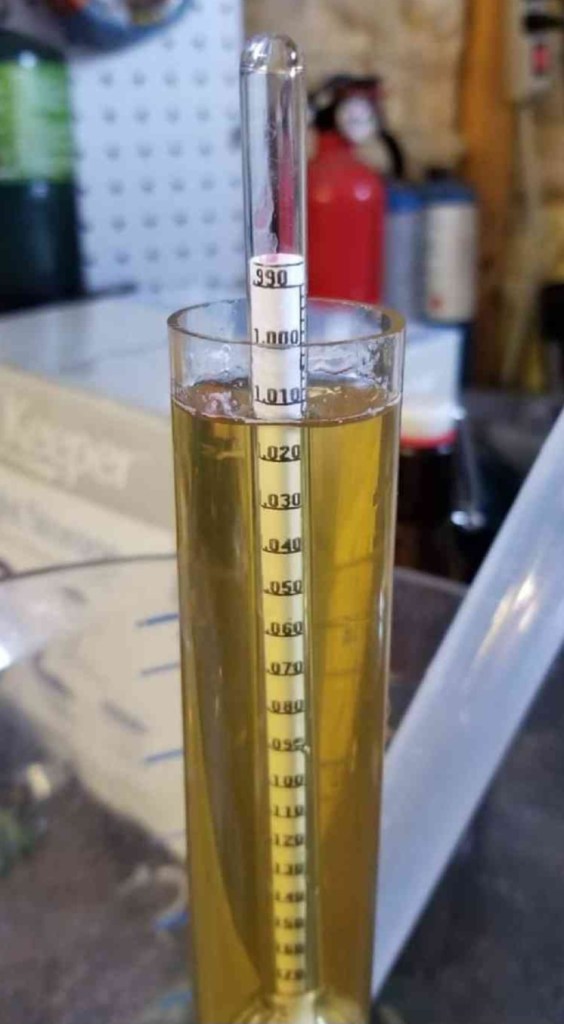
This is how most people start their gravity checking. Hydrometers are cheap, and reliable enough for our purpose and can be used just as easily during and after fermentation. However they do require a rather large sample size. (comparative to our homebrew scale of brewing)

The refractometer is another tool used for gravity. This instrument uses the way light bends in the liquid to get its readings. One of the pluses of using a refractometer is the amount of sample needed. Just a drop or two is enough to get a reading. However a post fermentation reading requires additional calculations.
Both tools as you see have their goods and bads, but both will work at every stage of your brew. A lot of people (like me), used the Refrac for everything pre fermentation, then switch to Hydrometer for the final reading…. and the little sampler of the beer.
Now we are getting somewhere. So when do we check gravity,, and what do the different readings mean?
There are a few points during the brew day that taking readings make the most sense for most of us brewers. Pre boil, end of boil, post boil/OG, during fermentation, end of fermentation/FG.

Pre boil. After collecting your wort, but before starting the boil. Most brewing programs will give you an approximate Pre boil reading to check. This number will be lower than your post boil reading due to boiling off and concentrating the wort. This reading is where you are starting to calculate mash efficiency, and is a nice insurance reading. If something happened to go wrong in the mash, its easier to deal with it here and now.
Boil. Taking readings during the boil is another of the insurance readings. Some outside effects may be affecting the boil rate. By taking readings towards the end of the boil you can determine if you will want to adjust power or times.
Post boil/OG. This is our pre fermentation reading, or OG (original gravity) Our starting number for determining ABV. Checked after any post boil or flame out additions. Usually before transferring to a fermentation vessel. There isnt a whole lot you can do if something is far off at this point, so the first two readings are fairly important.
Fermentation. Taking readings here is to confirm that fermentation is complete. Take readings over a couple of days, and if there is no change, the fermentation is done.
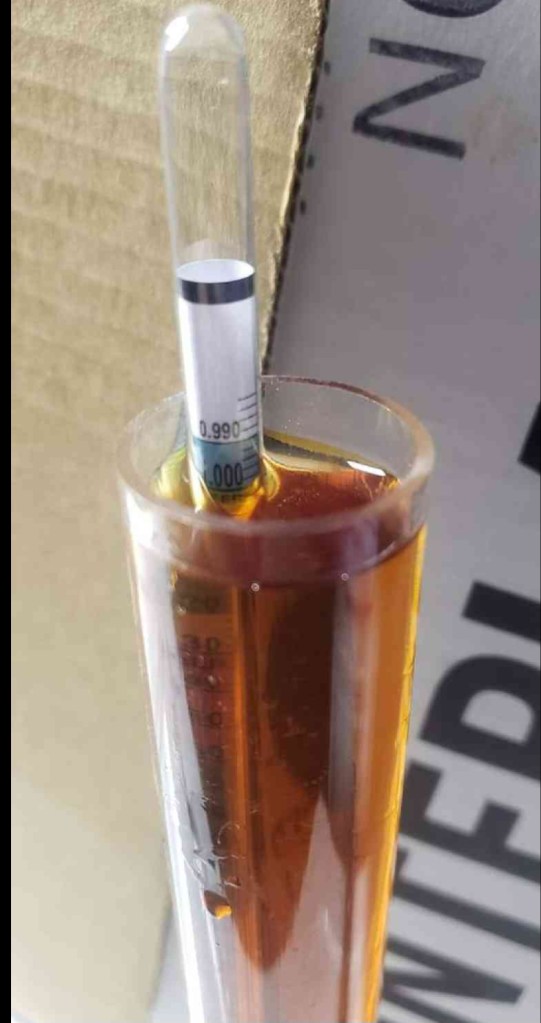
Post fermentation/FG. Final gravity. Just what it sounds like. Taken after fermentation is complete, but before any backsweetening would happen. This reading is used in conjunction with the OG reading to determine ABV.
(There are online calculators to do this math for you,, but we used to have to… (OG – FG) * 131.25 to figure it out)
Not every one takes all of those readings all of the time. Some take more than that. I would suggest at least taking the pre boil for sure it really will help you figure out a problem at some point, and then the OG and FG.
So what can you do with off readings?
Well it kinda depends on when you catch it, and what you’re expecting as a final product.
At the pre boil
If you are low, first thing I’d do is check my wort volume and crush. Do I have too much wort? Boil it a little before starting the timer.
Is my crush off? Tighten it up for next batch.
To high? Sparge more or add some water.

Anything wrong or off at this point is usually due to incorrect initial system measurements or grain crush. Take notes and adjust your numbers, strike and sparge water volumes for the next brew. This is what “dialing in” your system is.
Post boil/OG.
If your pre boil numbers were on and your are…
Low: check your volume (make sure to account for temp) you probably have too much wort and didn’t boil off enough.
(Or is a worse scenario that I’ve had happen… you have a leak in your chiller! I wouldn’t have known with out checking my gravity)
Too high: you probably boiled off too much.
Again, take note and adjust your initial water volumes for next brew
Post fermentation/FG
If everything was good up until now,, then you are surely looking at either a yeast problem, temperature problem, maybe mash temp problem, or contamination problem.
There isn’t a whole lot to be done now, except look at the mentioned parts of your process.
There you go.. some info on the gravity reading. Easy, but definitely important for letting you know important parts of not only your product,, but your process.
.
 9stripe Brewing