What’s to come

Since I am restarting and revamping this 10 year old blog, I thought maybe a  re-introduction would be a good idea.

I am a homebrewer. Been at it for nearly 30 years. I’ve learned a lot in that time.

My actual brewing process has changed very little since I first started. In fact I still have and use some of my original equipment.

Basic techniques and principles don’t really change, but the means to get there sometimes do.

Now days there seems to be a bigger push for complete automation, but I still love the process. I want to control the beers creation, so I am a bit more hands on than most because I think that is the best way to understand what is going on and why. That is how you become a better brewer.

I will admit that I am slowing down in production now days. Twice a week brewing has turned in to twice a month brewing. And 5 gallon batches have mostly turned into 3 gallon batches.

This also means I have more time for editorials, education pieces, and maybe some outside the brewery interviews of other homebrewers and their specialties.

Plus just in the 10 years this blog has been around quite a few things have changed in media and social tech. So I should probably go back into the vault of posts and re-examine them for updates, corrections or just filling in of the blanks.

In other words.. there will be a lot more content in various forms showing up in the near future.

As always.. stay tuned.
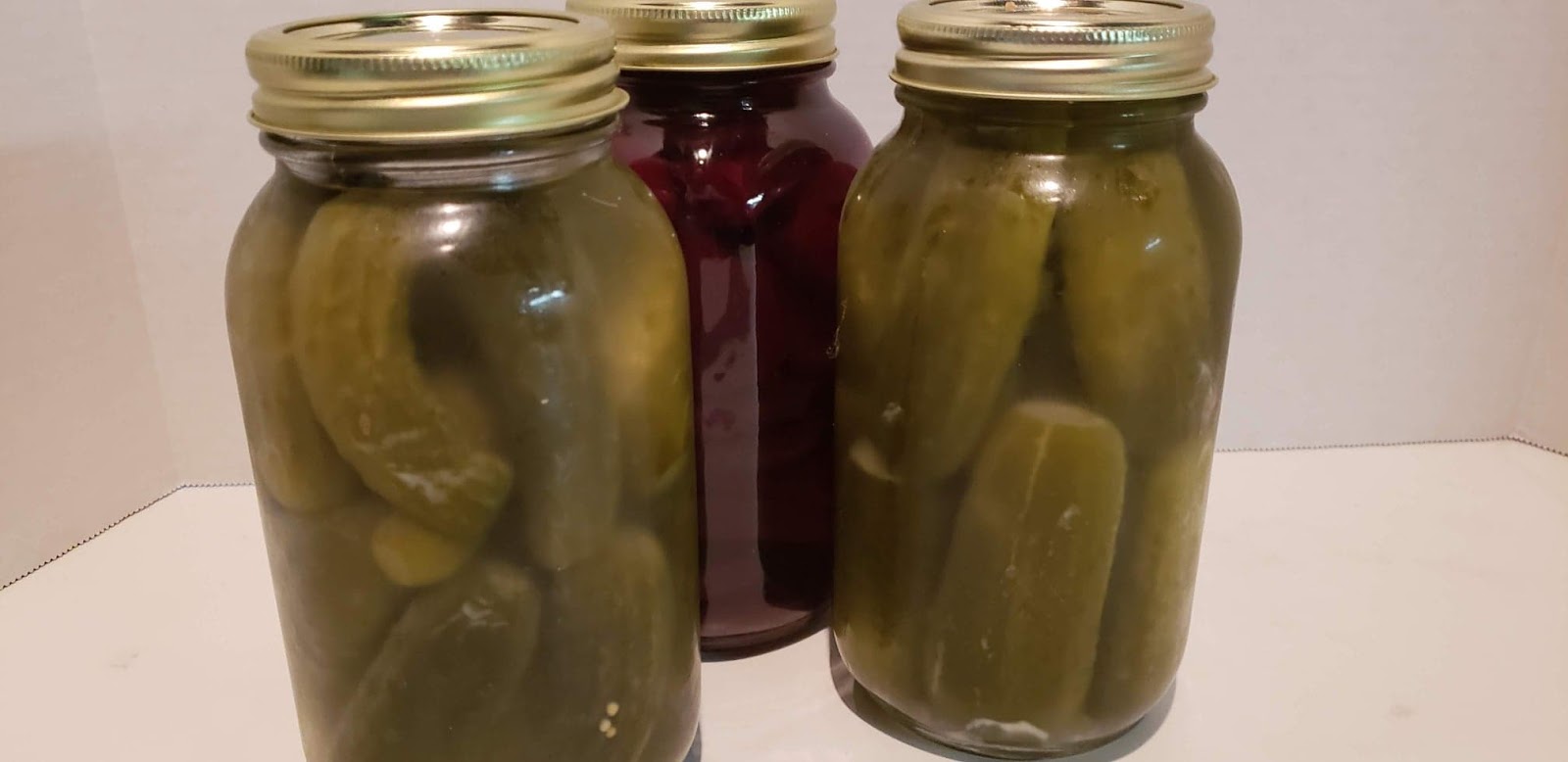
A Quick Ferment Guide

Have had several people now asking how to get started in fermenting all of the beans and pickles or all the veggies you can find this time of year.

Its just too easy not to do it. You basically need two things. 

JARS–Get a couple quart mason jars with rings and lids. (Pints are just a bit small, save the bigger half gallons for later) Even the bigger pickle jars will work.
SALT–Kosher or pickling salt. None of the iodized stuff. (Mortons Canning and Pickling Salt)
WATER–Tap water is fine but try to use non-chlorinated.
Thats it!
———————————————–

What we are trying to do is simple. Cover the veggies with a salt water solution to stave off any weird yeasts or bacteria long enough for the GOOD bacteria..Lactobacillus, to take over and start fermenting.

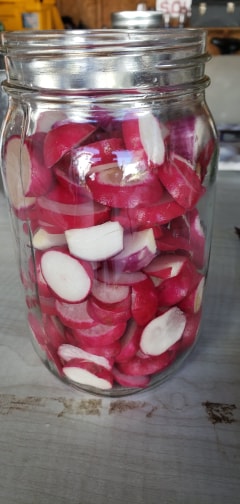
The easiest way to get started is to grab a bag of green beans, carrots, peppers, cukes or like for this.. Radishes
Slice or chop your veggies into smaller pieces 
Pack them fairly tight and up to the neck of jar.
If you have spices, add them now.
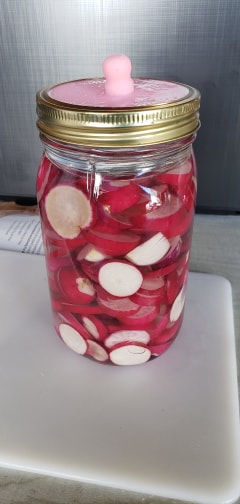
pour in your brine (will show this below) and fill the jars up over the veggies but leaving a bit of space from the top.

Put your lid on but not so tight,, if you have airlocks (Also see below) then use those now.

Set in a warm place. A week is good, 2 weeks might be better. (If you do not have airlocks, crack open the lids every other day to let the pressure off.)
Thats it!
Eat. and just store the rest in the jar in the fridge.


Now,, what exactly is this Brine? 
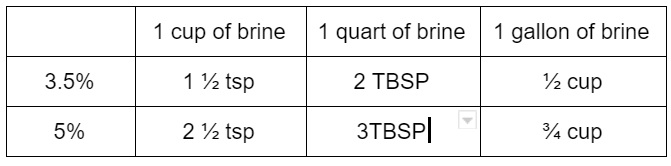
Just the salt water solution you pour over the veggies. What we are looking for is somewhere between a 3% and 5% salt solution. (3.5% is my usual because of the easy measures)
Sounds technical, but nope. Use the chart below to figure how much salt for the amount of brine your making. Just stir it up and its done.

 Tips:
Try to pack tight enough that the food stays under the brine level. 

Some white film may form on top… DON’T WORRY,, that’s just the natural yeasts from the veggies. If you do get some, just spoon it off the top and add more brine if you need to.

Experiment with more/less spices or veggie mixes.. Share with friends 


Some helpful things to use.
Airlocks
You can buy lids with a hole for a brewing airlock,, or the new silicon lids. These are great because you don’t need to burp jars.
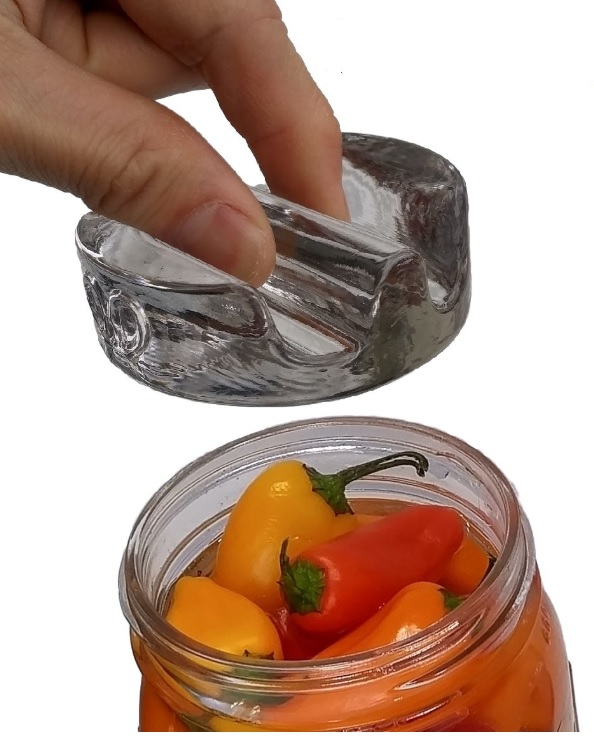
Jar weights
Just a round piece of glass or stone that fit inside the jars to keep the food under the liquid. Mostly for wide mouth jars.
————————————————
You can get more technical and involved, but using this quick guide will get you started so you can ferment any veggie out there. 


(kraut is slightly different, but same idea. I will make a quick guide for that later)

Alt

A couple of us are planning on entering the Germanfest Stein Challenge. A beer contest for only German style beers.

I chose to brew an Alt Bier. I have brewed Alts a couple of times and they have been good beers,, not sure how they would score against the guidelines,, but we will see I guess.

I also used this beer to start messing with water. We do have decent water here, but a few things can be done. I didn’t go all out on the water,, so I went with just a 1/4 tsp Gypsum, and a 1/4 tsp calcium chloride.. oh and 2oz of acid malt.

The rest was just an old Alt recipe that I’ve made before except I used Maris Otter instead of the Pilsner malt. just because I wanted the malt to stand out a bit more than usual since its going to a contest.

  • 4.5 lb Munich malt
  • 4 lb Maris Otter
  • 2oz black pat
  • 4oz crystal 40
  • 2oz Acid malt
  • 1oz Perle @60
  • 1oz Spalter @15

Went with a Medium body mash of 154, And used Munich dry yeast. Munich Dry yeast?… aint that a wheat yeast? Yep. But it gives that certain “Germanish” aroma and flavor profile.

Skipping ahead to today,, I just kegged this beer and it is what i was looking for in the malt, hop and yeast profile,, but I do have to say that it does seem a bit,, mineraly or something in the feel of it. I am assuming from the water additions.

I’m not yet saying that its a bad thing,, just that I did notice it right away. And since I have been brewing with this same water for 25 or so years,, pretty sure I would notice something different. I will how ever, be keeping track of this one a bit closer and see how those additions affect the final beer.