Oh the changes IPAs have gone thru in such a short time. The difference between one today and one from 20 years ago is very different. There used to be a malt component to them. Hops, yes, but there was malt to give it a little balance.
This is not the case any more. There was an arms race in on the hop side that changed IPA, and left everything one sided. But I want those forgotten IPAs. So lets get one going that have the roots of the past versions, but with maybe a bit of newer.
As you can see this is really just a old recipe I had that I swapped a few things to make it feel a bit modern but keep the original body and malt tones.
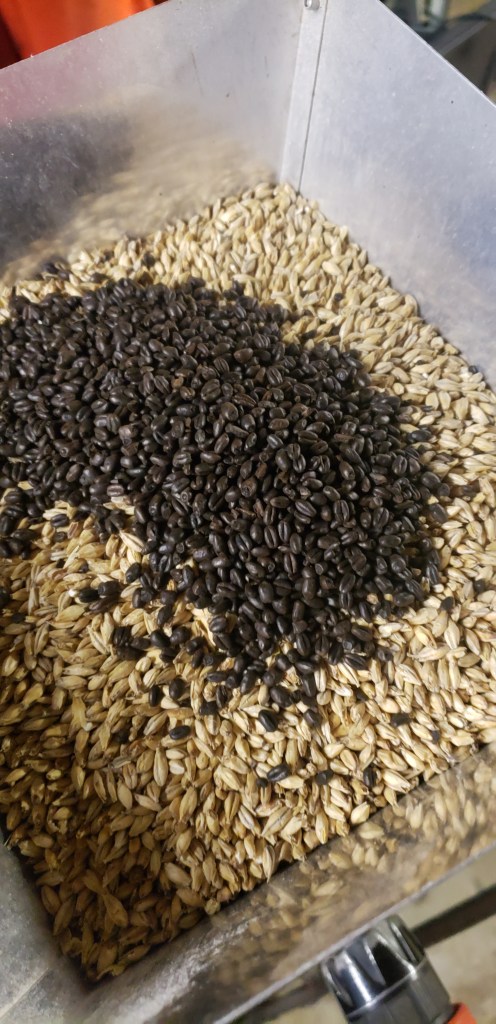
The bittering hop was Chinook and I changed to the Summit. So the IBU did go up a bit. And the Midnight Wheat used to be Black malt, so we won’t be getting and of the roast bleeding through.
And I will note that I did forget to adjust this recipe from my use of a mash tun to the Mash and Boil that I am using today,, so I am going to expect a bit less efficiency.
Normally I would be expecting around 1.060 for the OG using my tun. But pretty sure the MB will give me 1.054. I could easily add a bit more 2 row, but I probably won’t.
Next up going to be a saison. The snow shoveling months are coming so I will be needing an easy going beer, since all I seem to have right now are bigger ones.
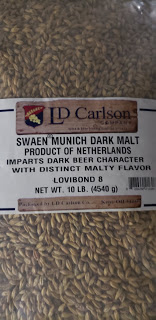
I have a bit of Dark Munich left, and have been putting bits of it in my beers for a little extra boost. So I figured, why not a quick blurb on this Swaens Dark and other Munich Malts in general.
As the name implies, Munich malt was once much more regional specific to European areas like Germany and surrounding areas,, but not because the grain its self is special or different somehow, but rather the way it is processed.
It’s usually a 2row but there are 6row versions. But what makes Munich different from your normal Pilsner or regular 2 row base malts is Munich keeps a much higher moisture content before the kilning process begins, Kinda sorta like a crystal malt,, but not as extreme.
By keeping more moisture in the grain at kilning, Munich gets very different flavor, and color traits than other base malts.
While most 2 row malts are in the 3-4 SRM range, Munich is generally in the 5-7-10 range. Now 20,, even 30 SRM versions are becoming available. And each one of these variations brings subtle changes to that bready, grainy malty flavors and aromas that are the trademark of Munich
And those changes generally get more intense the darker you go.
For example, this Swaens Dark is labeled as only 8 but it really has somewhat of a coco flavor to it that not present in the 5.
Lighter versions have no problem being used as 100% of a grain bill because they still retain enough diastatic power to fully convert their starches into the sugars we need.
However, the darker versions have much lower power and can struggle to fully convert, so they are more often used with a lighter base malt for conversion.
And thats what I recently found out about this Dark Munich. This Swaen Dark is labeled as only 8 Lovibond,, but apparently it is a bit lower in power because I have been doing smash beers with it and not getting quite the numbers I should. So from now on though, I’m gonna add some regular two row with it when I use it as the main grain.
I could not find any actual numbers anywhere,, but every single site that I looked at mentions the lower power.
A little goes a long way with these darker Munichs, so they are usually used to secondarily add depths or layers of flavor to your grain bills. Not “usually” the main grain, but German style beers such as Oktoberfests, Bocks, Marzens and the like are famous for their heavy Munich use, but those are far before the newer 20 and 30 varieties arrived. But then again, nearly every style of beer out there can use it to some degree for a bit of its malty goodness.
And now today with nearly every Maltster out there making a version of Munich malt,, the varieties and variations are endless.
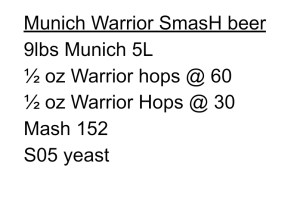
I don’t exactly know what I’m gonna brew next with it, or what the proportion will be,, but for now,,, Here is a quick and easy Munich Smash recipe to get a feel for the general characteristics of the Munich malt.
And if you go to brewing with Briess.com in the recipe section, you will find a recipe that uses the Dark Munich Dark Munich Amber
When the Saisons started showing up on shelves I wasn’t a fan of them. Those yeast profiles just were not my thing. But the rest of the dryness, sometimes spiciness really stuck out for me. And I eventually found that I kinda liked them.
So I have brewed a few here and there, and changed some things to get back to where I like this style, since its very hard to find a plain ol’ Saison nowadays. No fruits, no spices, no nothing.
I use a regular old US two row malt. I think it lets the other things like the wheat and Saaz hops poke through a little more. Rye malt is great here as well, just don’t get crazy with it. It would cover up a lot in this bare bones version.
Get your bittering somewhere in the 25-30 range. Been using Tettnang hops for my smaller batches or Target hops for bigger batches just because of the bigger bang for the buck Alpha. These give a decent amount of that earthy Saison thing without standing out. Saaz hops for the late editions is almost mandatory for me. They seem to work best if kept around the 10-15 minute range.
And probably the most important ingredient in a Saison…the yeast. I’m not one for the big blasts of banana, so I stick with the Belle Saison dry yeast. It only has a bit of background banana, but it gets almost a black pepper and lemon/orange thing going when purposely underpitched. Ferments fairly dry, but not nutz. But it doesnt like to clear all that well. But hey,, thats fine in this beer!
I wouldn’t usually even consider adding fruit, but for some reason raspberry just feels like it would work here. Small amounts though. Raspberry is pretty powerful and this is a very light profiled recipe.
Any way,,, this is what I’ll be brewing this Saturday for the 2020 “Learn to Brew Day” Check out my gallon version.
3 gallon Saison OG 1.054, 30 IBU -5 lbs US 2 row -½ lb crystal 10L -½ lb wheat malt red or white (malt,, not flaked wheat) -1oz tettnang hops @60 -1oz Saaz at 10 min -¼ packet Belle Saison yeast. (we are trying to stress it a bit for character. Don’t worry, that’s more than enough yeast) Mash at 150. Ferment a bit higher than normal.. 70F
May not be “traditional” in a strict sense, but it’s what I want in a Saison.

 9stripe Brewing